Ferroforms
 Ferroforms: A Landscape in Motion
A Sculpture in Motion
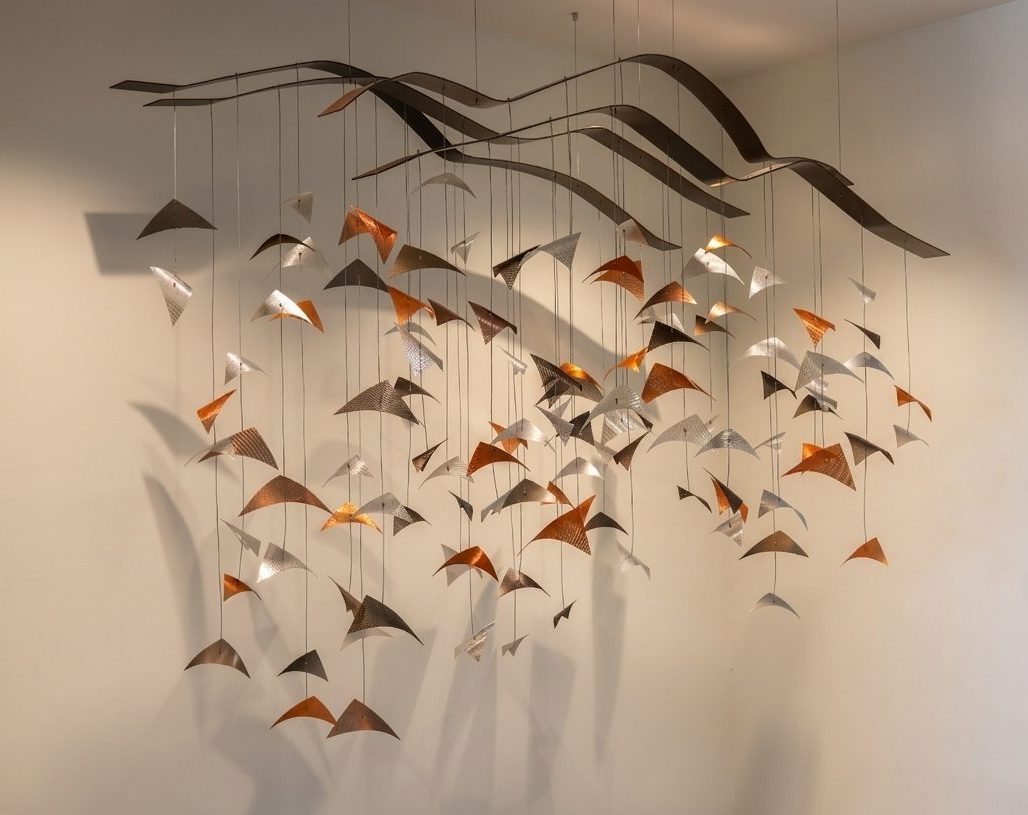
Positioned above the stairway leading to the lower level of The Clubhouse at The Woods, a striking sculpture floats overhead—capturing the attention of those walking below and those gathered in the adjacent dining room. Suspended from the ceiling, Ferroforms stretches outward in a light, flowing composition, uniting these spaces through a single, shared visual experience.
A Living Landscape Above
The sculpture unfolds as a suspended kinetic installation composed of dozens of small, curved metal elements. Each form hangs delicately from thin, nearly invisible vertical cables attached to long, gently wavy bars above. These bars sweep across the ceiling like ribbons caught mid-breeze, already suggesting motion before the eye begins to follow the layered arrangement below.
The individual elements resemble folded wings or drifting leaves, gathered in a loose formation that evokes a flock in flight. Their surfaces alternate between warm copper tones and cool silvers, with subtle perforations that catch and diffuse the light. Overhead illumination casts soft, shifting shadows along the wall, extending the sculpture beyond its physical form and creating a sense of depth that changes throughout the day. From the dining room, the piece appears almost like a moving landscape in the distance; from the staircase, it becomes immersive, surrounding the viewer as they pass beneath it.
Rooted in Cornwall’s History
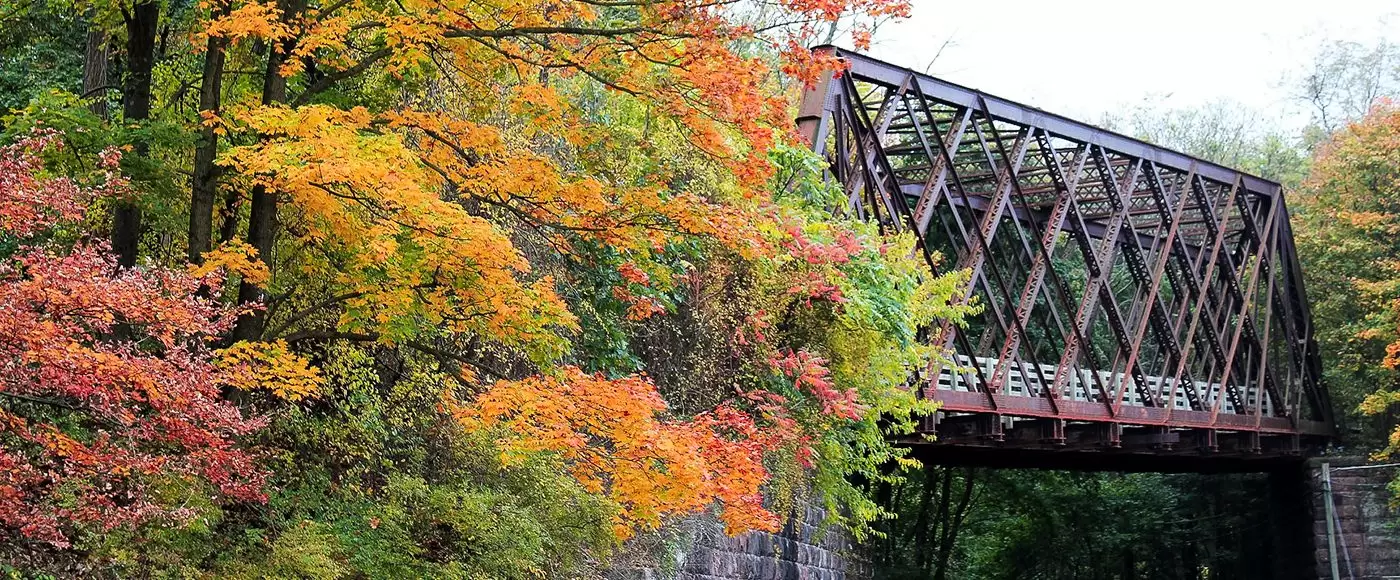
Though abstract in design, Ferroforms is deeply connected to the story of Cornwall, Pennsylvania—a place shaped by its iron-mining past. Once home to the world’s largest open-pit iron mine, the land itself bears the imprint of industry transformed over time into the rolling hills seen today.
The sculpture reflects this history through suggestion rather than depiction. The flowing upper bars echo the contours of the landscape, while the clustered forms below hint at the shifting earth, discarded rock and evolving terrain left behind by mining. The metallic palette—copper, bronze, and silver—quietly recalls the iron-rich ground beneath the surface. Seen from different angles, the forms can be read as tree lines, geological striations or fragments lifted from the earth and suspended in motion.
The Artist’s Journey
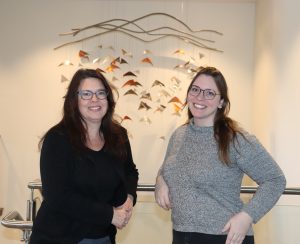
Artist Talley Fisher brings a unique perspective shaped by both science and art. Raised in rural Pennsylvania, Talley spent early years immersed in the natural world while observing sculptural work in the studio of father Rob Fisher. That dual influence guided studies in field biology and landscape architecture before a return to sculpture following her father’s passing, when Talley completed existing commissions and carried the practice forward.
Working alongside Studio Manager Olivia Calef—whose own interests in industrial materials and texture complement the process—the team crafted Ferroforms over the course of several months. Each aluminum piece was cut, curved and finished by hand, with careful attention to light, translucency and movement. The installation was first created as a 3D model, then assembled in the studio and disassembled into sections and precisely reconfigured onsite, ensuring that every element aligned with the intended flow of the composition.
Material Meets Motion
Despite the industrial materials—powder-coated aluminum, anodized finishes and stainless-steel cables—the sculpture feels remarkably light. Perforations within each form allow light to pass through, creating a layered interplay of opacity and transparency. The triangular, geometric shapes strike a balance between organic and engineered, reinforcing the dialogue between nature and industry.
Even in still air, Ferroforms suggests motion. Subtle shifts in perspective or lighting cause the piece to transform, while faint air currents may gently animate the suspended elements. The resulting effect is one of quiet dynamism—a piece that never feels fixed, but always in a state of becoming.
A Shared Experience
Positioned between movement and gathering—between the staircase and the dining room—the sculpture serves as a visual bridge within the Clubhouse. Residents descending the stairs encounter it up close, while those dining nearby experience it as a shifting panorama overhead. In both cases, the artwork invites reflection.
Some see birds in flight. Others recognize echoes of the Cornwall landscape. Still others simply appreciate the way light and shadow play across the wall. In its abstraction, Ferroforms leaves room for interpretation, allowing each viewer to bring personal meaning to what they see.
A Gift Rooted in Love for Art and Community
This installation was made possible through the generosity of Kathryn Lillie, who sponsored the artwork in honor of parents Robert and Mary. All three shared deep connections to Cornwall Manor, forming lasting ties within the community over many years. A committed member of the Artful Connections Art Council, Kathryn believed strongly that art enriches both individual lives and the collective spirit of a place.
In a message shared with the community, the Lillie family expressed a simple and meaningful hope: “We hope this unique artwork will uplift and inspire all who experience it—Cornwall Manor residents, staff, and visitors alike.”
Their gift reflects not only an appreciation for art, but also a belief that beauty belongs in shared spaces—where people gather, connect and feel at home. Within the Clubhouse, Ferroforms stands as a tribute to that vision and to the Lillie family’s enduring connection to Cornwall Manor.
Honoring Past and Present
The Clubhouse at The Woods represents growth for Cornwall Manor, blending modern amenities with a respect for history. Within that setting, Ferroforms becomes more than decoration—it becomes a tribute. It transforms the legacy of iron and industry into something weightless and expressive, suspended between memory and imagination.
In that space above the stairs, visible from many angles on the main floor, Cornwall’s history is reimagined in light and motion. It rises, shifts and catches the light—alive in form and ever evolving.
