
Forged in History: Art from Cornwall Iron Furnace
Forged in History – Cornwall Iron Furnace
Adjacent to the Buckingham Campus, the Cornwall Iron Furnace is one of the best-preserved examples of a charcoal iron blast furnace in the United States. Built in 1742 by Peter Grubb, a Quaker ironmaster, the furnace quickly became a vital part of early American industry. It was designed to smelt iron ore using charcoal as fuel, limestone as a flux and water power from the nearby Hammer Creek to drive its massive bellows. Over time, the furnace expanded and modernized, playing an important role in supplying iron for tools, stoves and machinery throughout the 18th and 19th centuries.
During the American Revolutionary War and continuing through the Civil War, Cornwall Iron Furnace contributed significantly to the nation’s military efforts by producing cannon, shot and other iron goods. Remarkably, it remained in operation for nearly 150 years, finally ceasing production in 1883 as newer, more efficient coke-fueled furnaces replaced charcoal operations. Today, the site is a historic landmark and museum operated by the Pennsylvania Historical and Museum Commission. Visitors can explore the original furnace structure, surrounding buildings and exhibits that illustrate the lives of the workers and the technological advances of early ironmaking in America.
The Cornwall Iron Furnace – Main Complex
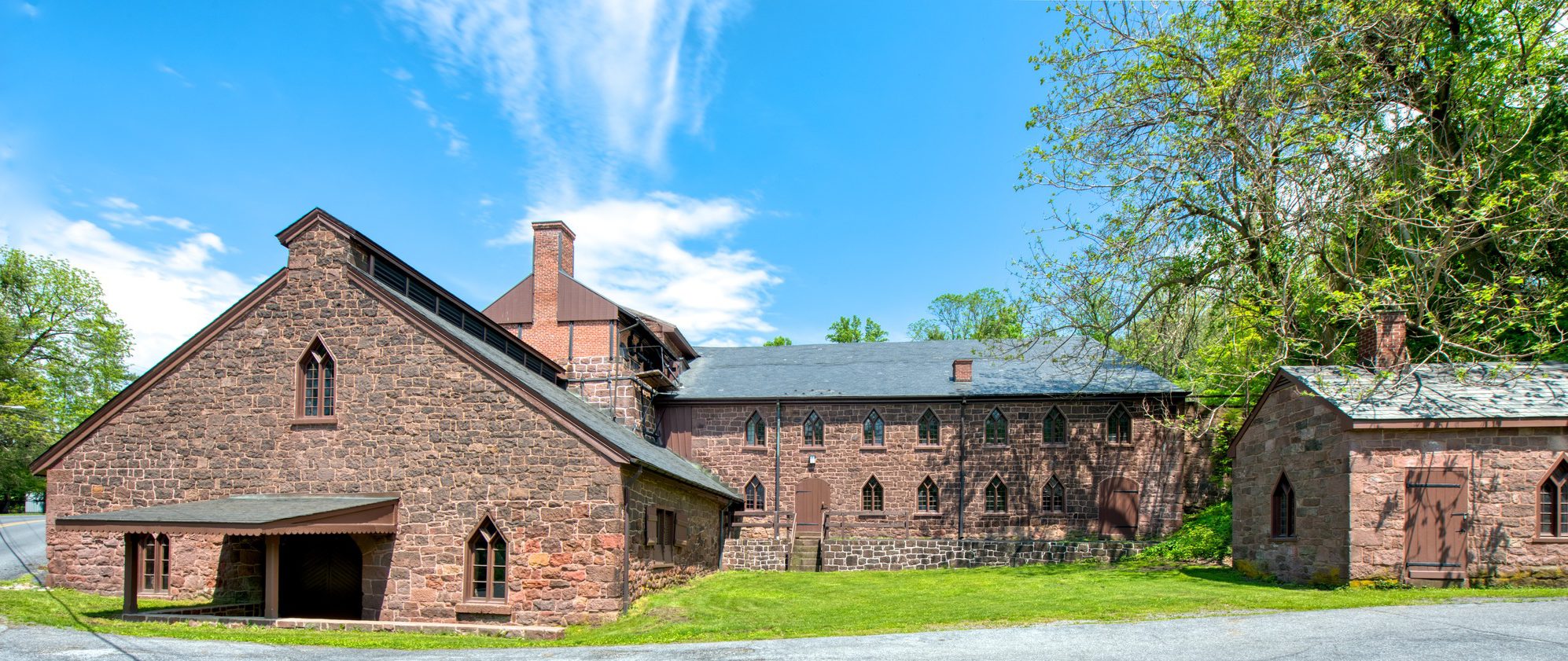 The main complex is a rambling architectural marvel that uniquely encapsulates the 19th-century ironmaking process under one interconnected roof. While the industrial site dates back to 1742, its current estate-like appearance is the result of an extensive mid-1850s remodel overseen by the prominent Coleman family. Unlike the stark, utilitarian designs typical of most industrial facilities of the era, the Colemans encased the operations in a striking Gothic Revival style. Built with locally quarried red/pink sandstone (brownstone), trimmed with limestone accents, and capped with a slate roof, the building features prominent pointed-arch Gothic windows with dark wooden trim across its entire facade.
The layout naturally segments the production line, beginning with the Cast House on the far left. This large gabled section features a wide, low awning over its entrance, providing a space where workers historically tapped molten iron from the furnace hearth and poured it into sand molds to yield pig iron bars, stoves, and wartime weaponry. Moving to the right, the interconnected buildings house the furnace stack itself and the charging platform where laborers dumped ore, charcoal and limestone. Adjacent sits the engine room, which historically housed a 20-horsepower steam engine tasked with driving the heavy blowing equipment that blasted air into the furnace. Because the Coleman family and the Commonwealth of Pennsylvania chose to deliberately preserve the site rather than scrap it after its 1883 closure, it stands today as the only fully intact, charcoal-burning iron blast furnace in its original plantation setting surviving in the Western Hemisphere.
The Blacksmith Shop and Wagon Shop
An iron plantation operated as a fully self-sustaining community, requiring support buildings capable of keeping operations moving 24 hours a day, 7 days a week. The historic Blacksmith Shop and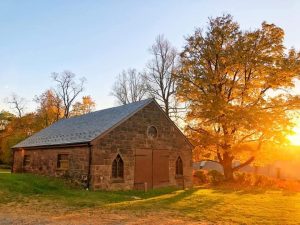 Wagon Shop, also known as the Wagon Master building, is an essential auxiliary structure located on the museum grounds. To maintain visual harmony across the plantation, this support building was updated in the same Gothic Revival style during the Coleman family’s 1856–1857 site renovation. Constructed out of matching local red/pink sandstone, its architectural pedigree is instantly recognizable by the pointed-arch windows framing the large central doors and a small, circular window centered in the gable.
The workshop was divided into two vital industrial functions that kept the plantation running. The Wagon Shop bay, featuring large double wooden doors, was built to handle the constant maintenance of heavy-duty wooden carts and wagons. Teamsters used these vehicles around the clock to haul charcoal, limestone flux and iron ore from the nearby Cornwall Banks directly to the furnace charging platform. Inside the other half of the structure, plantation blacksmiths forged and repaired essential iron hardware. Their responsibilities ranged from manufacturing industrial tools for the furnace laborers to shaping wagon wheel rims and shoeing the horses and mules that pulled the heavy supply carts. Today, the workshop sits alongside other surviving structures from the era, including the abattoir (smokehouse) and the charcoal barn, which has since been converted into the site’s Visitor Center.
The Overhead Railroad Truss Bridge (Cornwall-Lebanon Railroad Bridge)
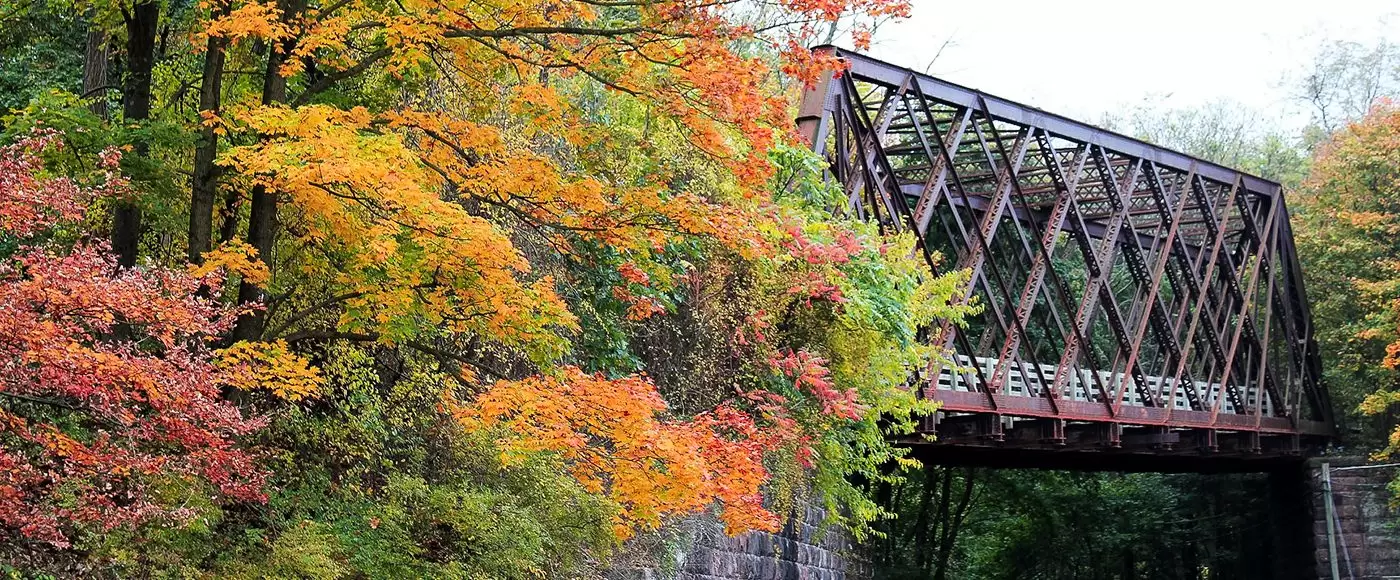
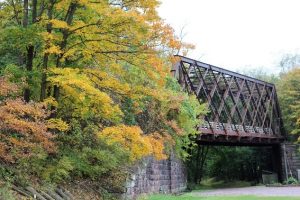 Located along the Cornwall segment of the Lebanon Valley Rail Trail (LVRT), this massive iron structure is a permanent monument to a bitter, Gilded Age corporate war. Known locally as a “Bridge to Nowhere,” trail users often notice that this bridge spans an ordinary trail path and empty space rather than a river or ravine. It is a rare surviving example of a railroad-over-railroad grade separation, built entirely to resolve a cut-throat 1880s conflict over the transportation of lucrative iron ore from the Cornwall Iron Mines.
This corporate battle pitted the original Cornwall Railroad against the newcomer Cornwall & Lebanon (C&L) Railroad. The Cornwall Railroad, aligned with the rival Freeman family interests, already controlled the existing ground-level tracks and the right-of-way. When industrialist Robert H. Coleman created the competing C&L Railroad in 1882 after a personal fallout, his line was legally blocked from crossing the Freeman tracks at grade. Coleman responded with an expensive engineering feat, constructing an elevated rail path that crossed perpendicularly over his rival’s line.
The heavy-duty, through-truss iron bridge was engineered to withstand the punishing weight of steam locomotives pulling heavily loaded iron ore and charcoal hopper cars. Echoing the design language of the Cornwall Iron Furnace, the bridge stands on monumental, high-quality ashlar red sandstone (brownstone) abutments quarried from the same local stone beds. Decades after industrial rail traffic cleared out of the corridor, the line was saved from abandonment. The upper deck of the truss bridge has been safely redecked with protective pedestrian railings, allowing modern runners, hikers, and cyclists to cross safely above the trail while taking in panoramic views of the surrounding Pennsylvania woodlands.
Industrial Heritage and Renewal
Together, these striking pieces of artwork capture the enduring spirit of the Cornwall iron plantation, transforming raw industrial history into a narrative of community resilience. By displaying these scenes within the Clubhouse, Cornwall Manor beautifully reflects its deep, foundational connection to its historic surroundings. These vibrant depictions do more than just decorate the walls; they serve as a daily bridge between eras—honoring the region’s monumental industrial heritage while seamlessly celebrating more than seven decades of community, care, and purposeful renewal on these hallowed grounds.
